Every X-ray image begins with electricity. Before a single photon leaves the tube, a power supply has to turn ordinary mains power into tens or even hundreds of kilovolts, steady enough that the beam behaves the same way on the thousandth scan as it did on the first.
How that conversion happens has a direct effect on image quality, dose, size, heat, and reliability. That is why design teams at an integrated X-ray source manufacturing company spend so much effort on the power stage, and why high-frequency conversion has become the standard approach in modern systems. Here is how it works and why it matters.
From Line Frequency to High Frequency
Older generator designs used large transformers running at the mains frequency of 50 or 60 Hz. These units were heavy, bulky, and produced a high-voltage output with noticeable fluctuation.


High-frequency designs take a different route:
- Rectification: incoming AC power is converted to DC.
- Inversion: the DC is chopped by fast electronic switches into AC at a much higher frequency, typically tens of kilohertz or more.
- Step-up: a compact high-voltage transformer raises the voltage.
- Rectification and multiplication: the high-voltage AC is converted back into smooth DC and applied across the X-ray tube.
Because the transformer works at a much higher frequency, it needs far less core material to handle the same power. That single change drives most of the benefits below.
Lower Ripple, Cleaner X-Ray Output
Ripple is the small fluctuation in voltage across the tube. When the voltage dips, the tube emits lower-energy photons that add dose but contribute little to the image. When ripple is high, the X-ray spectrum is wider and less predictable. High-frequency conversion produces a much smoother DC output, often with ripple of only a few percent or less. That brings several advantages:
- More consistent beam quality from exposure to exposure.
- Reduced unnecessary low-energy radiation, which helps lower patient or operator dose in medical and security applications.
- Better image contrast and repeatability, valuable for CT, bone densitometry, and inspection.
- More reliable measurements in analytical applications such as spectrometry, where stable intensity matters.
Fast, Precise Control
Because the switching frequency is high, the control electronics can react quickly. Modern generators use closed-loop feedback: the system continuously measures output voltage (kV) and tube current (mA), compares them with the commanded values, and adjusts the converter instantly.
This gives engineers several practical benefits:
- Accurate kV and mA setting, even as line voltage or temperature changes.
- Short rise and fall times, which allow brief, well-defined exposures.
- Pulsed operation, useful for gated imaging and fast scanning.
- Repeatability, so that settings produce the same result day after day.
For applications like conveyor-based food inspection or CT scanning, where thousands of exposures happen in succession, this speed and consistency directly affect throughput and image reliability.
Smaller, Lighter and Easier to Integrate
Smaller transformers and filtering components mean a more compact generator. That matters because OEMs are constantly trying to fit more capability into less space, whether it’s a portable security scanner, a robotic C-arm for industrial inspection, or a dental CBCT unit.
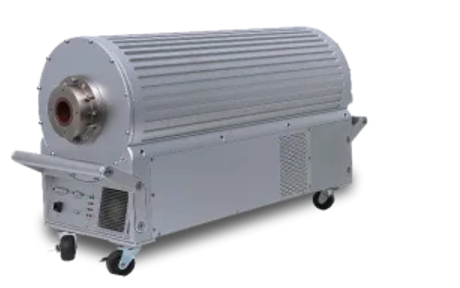
An integrated X-ray source manufacturing company can take this a step further by combining the high-voltage supply, the X-ray tube, and the control electronics in a single housing. This reduces external wiring and high-voltage cables, shortens the electrical path, and simplifies installation. The result is a source that is easier to mount, easier to cool, and easier to maintain.
See also: How to Start a Business Blog That Brings in Customers in 2026
Efficiency and Thermal Performance
Efficiency isn’t just about electricity bills. Every watt lost in the converter becomes heat that must be removed, and heat shortens component life and can cause output drift. Many high-frequency designs use soft-switching techniques, such as resonant converters, that turn switches on and off when voltage or current is near zero.
This lowers switching losses and electrical noise. Cooler operation means less demand on cooling systems, better long-term stability, and more headroom for continuous-duty applications such as inspection lines running all day.
Reliability and Safety Considerations
High-frequency conversion brings challenges as well as benefits, and good design addresses them directly:
- Electromagnetic interference: fast switching can generate noise, so shielding, filtering, and careful layout are essential.
- Insulation: high voltage at high frequency stresses insulation differently, so materials and spacing need to be chosen carefully.
- Arc protection: X-ray tubes can occasionally arc internally, so the generator must detect and limit the energy of an arc, then recover safely.
- Interlocks and monitoring: safety circuits, fault detection, and diagnostics protect users and equipment.
Well-designed systems also follow relevant electrical and medical equipment standards, which helps OEMs reach compliance more easily.
Where the Difference Shows Up
The advantages of high-frequency conversion appear across many fields:
- Security: stable output and compact form factors support baggage scanning, cargo inspection, and portable systems.
- Medical and dental: low-ripple output and fast control support clear images and efficient dose use.
- Industrial NDT: consistent beam quality improves defect detection in aerospace, automotive, and electronics components.
- Food inspection: reliable output helps detect glass, bone, metal, and plastic on high-speed production lines.
- Analytical: steady intensity improves measurement accuracy.
What to Look For When Selecting a Generator
When comparing options, ask about:
- Output ripple and long-term stability specifications.
- Accuracy and repeatability of kV and mA control.
- Size, weight, and cooling requirements.
- Built-in protection against arcs, overloads, and faults.
- Compatibility with your control system and interfaces.
- Level of customization and technical support available.
Conclusion
High-frequency power conversion improves X-ray system performance by producing smoother output, enabling faster and more accurate control, shrinking size and weight, and improving efficiency. Those gains translate into better image quality, lower unnecessary dose, higher throughput, and easier integration. For OEMs choosing a power platform, a high-frequency generator X-raydesign is now the practical benchmark, and the strongest results come from pairing it with careful thermal, insulation, and protection design.
VJ X-Ray develops and manufactures integrated X-ray sources and high-voltage generators for OEM partners worldwide. They combine more than three decades of experience in high-voltage design with compact, customizable products, helping manufacturers build X-ray systems with stable output, reliable performance, and simpler integration.